A passport does two things.
It proves identity, and it connects that identity to a system of rules, checks, and records over time.
That makes it a useful way to understand what Europe is building with Digital Product Passports and battery passports.
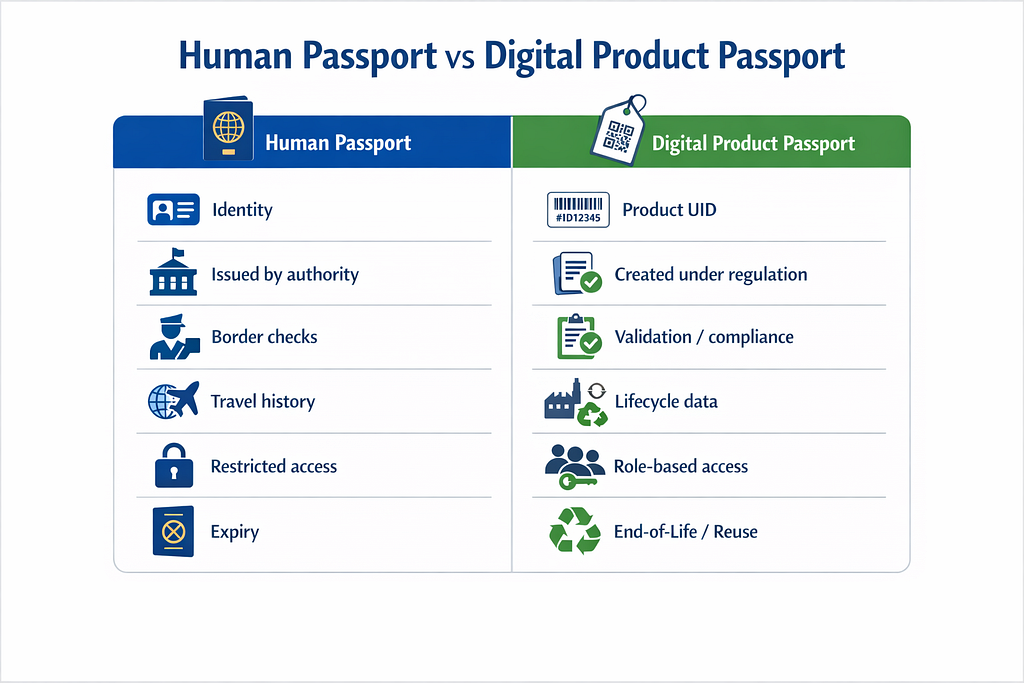
Not as a metaphor, but as a structure.
Because what is emerging is not just a digital label. It is a system for identity, validation, access, and lifecycle information.
Identity: Where It Starts
A human passport begins with identity.
Name, nationality, date of birth, and a passport number create a unique reference.
In the DPP framework, this role is played by a unique product identifier.
Under the Ecodesign for Sustainable Products Regulation (EU 2024/1781), each passport is linked to a persistent identifier, accessible through a data carrier such as a QR code.
This identifier is what allows product information to be:
- connected across systems
- accessed by different actors
- reused over time
Without it, there is no passport.
Issuance: Not a Document, but a Framework
A human passport is issued by a state.
A Digital Product Passport is created within a framework.
The regulation defines the structure. Product-specific rules define the content.
There is no single template for all products. Instead, the passport is defined progressively, depending on the product group and its requirements.
What looks like a simple QR code is backed by:
- identifiers
- structured data
- system components such as registries and access layers
Validation: Trust Is Built Into the System
A passport only works if it can be trusted.
That same requirement appears in the DPP framework.
The regulation requires passport data to be:
- accurate
- complete
- up to date
- machine-readable
The methodology developed by the European Commission’s Joint Research Centre adds another dimension.
Data is not selected arbitrarily. It is derived from:
- policy objectives
- use cases
- feasibility
- access rules
This creates a structured way to decide what belongs in a passport.
Lifecycle: More Than a Static Record
A passport is issued once, but used over time.
The same applies here.
A Digital Product Passport is not a fixed snapshot. It is connected to the product lifecycle, including:
- manufacturing
- use
- maintenance
- repair
- end-of-life handling
The JRC framework explicitly considers when data is updated, who updates it, and how it remains usable over time.
The Battery Passport: A Concrete Example
The battery passport under Regulation (EU) 2023/1542 is the clearest implementation so far.
From 2027, certain batteries must carry a digital passport with defined data categories.
These include:
- material composition
- carbon footprint
- recycled content
- performance and durability
- safety and compliance
It also introduces layered access.
Some data is public. Some is restricted to authorities and specific actors.
This makes the passport a structured record, not just a label.
Access and Granularity
A human passport belongs to one person.
A product passport can apply at different levels.
The regulation allows data to be linked to:
- a product model
- a batch
- or an individual item
The battery passport combines these levels, linking general product data with individual lifecycle information.
Access is also controlled.
Different actors see different parts of the passport, depending on their role.
End of Life: Still Within Scope
A passport expires.
A product passport does not expire in the same way, but it remains relevant beyond use.
Both the DPP framework and the battery regulation connect passport data to:
- reuse
- recycling
- material recovery
The passport continues to function even when the product reaches the end of its lifecycle.
A System, Not a Label
Seen this way, the term “passport” becomes more precise.
It is not just a way to display information.
It is a way to:
- identify a product
- structure its data
- control access
- maintain information over time
The battery passport shows how detailed this can become. The broader DPP framework is still being defined.
But the structure is already visible.