When people talk about the Digital Product Passport, the image is usually simple.
A QR code on a product. A scan. Some information on a screen.
But the real question is not the QR code. The real question is what sits behind it.
A Concept Defined, but Not Fully Filled
The Digital Product Passport (DPP) is introduced under the Ecodesign for Sustainable Products Regulation (EU 2024/1781).
EU Regulation 2024/1781 (ESPR)The regulation defines the DPP as a structured digital record containing relevant product information to support sustainability, circularity, and compliance.
But it does not define a fixed dataset.
Instead, it sets principles:
- Data must be accurate, complete, and up to date
- It must be linked to a unique product identifier
- It must be accessible via a data carrier (for example, a QR code)
- It must use open, interoperable formats
- It may apply at model, batch, or item level
What goes into the passport is not defined once, but determined later for each product group.
From Concept to Structure: How Data Is Organized
To understand how this information might be structured, the CIRPASS project provides a useful reference.
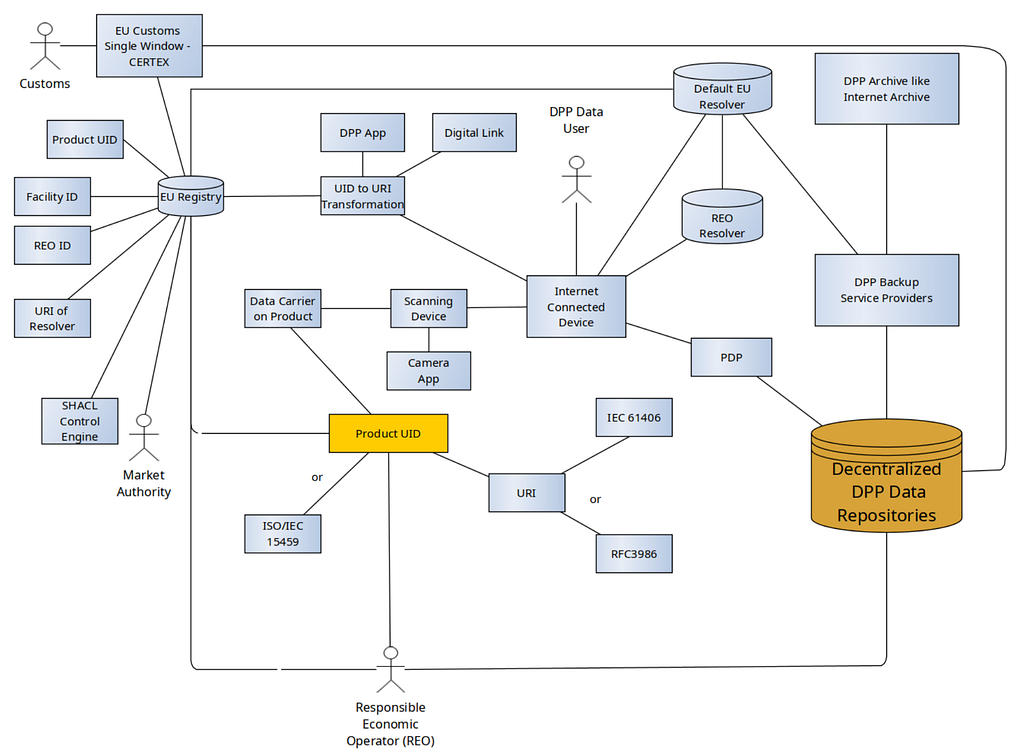
CIRPASS describes the DPP as:
- A structured dataset
- Linked to a product through a unique identifier
- Accessible via digital resolution mechanisms
- Managed across distributed systems
Its architecture introduces several key elements:
- Product UID and URI transformation
- Registry and resolver layers
- Decentralized data repositories
- Validation mechanisms
- Structured data representation using JSON-LD
The architecture also introduces validation concepts such as SHACL, allowing data to be checked against predefined rules.
This shows that the passport is not just a collection of fields. It is a structured, validated, and interoperable dataset.
Deciding What Data Belongs: The JRC Methodology
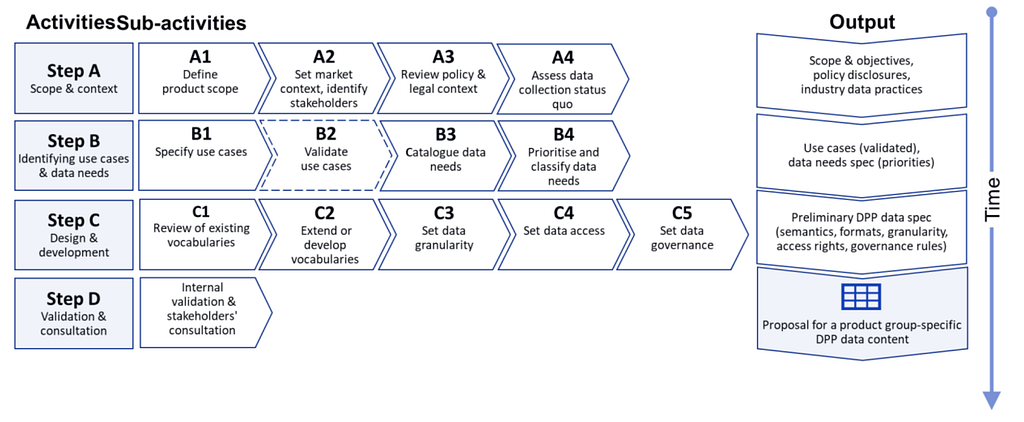
A key development in 2026 came from the European Commission’s Joint Research Centre (JRC).
JRC Methodology for DPP Data RequirementsInstead of starting with predefined fields, the methodology proposes a structured way to decide what data should be included.
It suggests that DPP data should be selected based on:
- Policy objectives
- Use cases
- Data availability
- Feasibility
- Access rights
It also introduces categorization such as:
- Essential data
- Recommended data
- Optional data
This adds an important layer to the DPP discussion.
The passport is not only about structure. It is also about how data is selected and justified.
A Concrete Example: The Battery Passport
The most detailed example available today comes from the EU Battery Regulation (EU 2023/1542).
Regulation - 2023/1542 - EN - EUR-Lex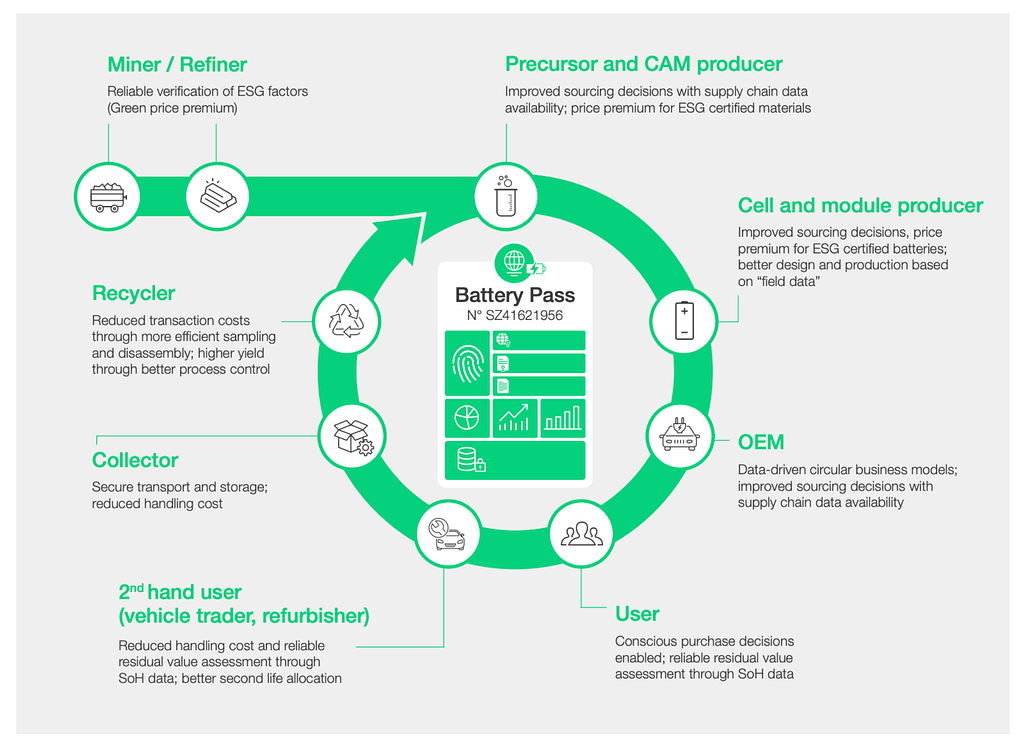
From 2027, certain batteries placed on the EU market must have a battery passport.
The regulation defines specific data categories, including:
- Material composition and chemistry
- Carbon footprint
- Recycled content
- Performance and durability metrics
- Responsible sourcing information
- Safety and compliance data
It also introduces a layered access model:
- Publicly accessible information
- Restricted data for authorities and operators
- Detailed lifecycle and performance data
The battery passport shows that a DPP is not a single flat dataset. It is a multi-layered structure with different audiences and levels of detail.
Multiple Layers, Not One Definition
Across these sources, a consistent pattern appears.
Different actors define different parts of the passport:
- The regulation defines the framework and principles
- Product-specific rules define required data categories
- The JRC defines how data should be selected
- CIRPASS defines how data is structured and validated
- Sector regulations like the battery passport show how it works in practice
Each layer contributes to the overall shape of the DPP.
A Structured but Evolving System
The Digital Product Passport is often described as a single concept.
In practice, it is a combination of:
- Legal requirements
- Data selection methodologies
- Structured data models
- Validation mechanisms
- Access control rules
- Product-specific implementations
The battery passport provides one of the first detailed examples.
Other product groups will follow with their own specifications.